(back)
Frank Furniture
brand world building, 3d, art direction
1st Year University Project
29.5.26
From Brief to Concept
In November, our group was handed the broadest possible instruction imaginable: create something about “the future of something”. The openness of the brief was initially overwhelming, but in retrospect I think that uncertainty was intentional. It forced us to think conceptually before practically, and to interrogate what actually interested us rather than immediately jumping toward aesthetics or branding. The project originally began under the idea of “the future of creativity”, with discussions surrounding different forms of creative expression and how creativity itself may evolve within increasingly digital societies. During this period I was absent more often than I should have been due to declining mental health, which disrupted my own consistency within the group early on. Despite this, I stayed involved remotely through messages and group discussions, where lists of possible directions were shared and debated.
As I looked through the themes we had generated, identity, originality, consumption, media, self expression, I realised that most of them could ultimately be collapsed into one central concern: authenticity. That realisation became the conceptual backbone of the project. We were not simply interested in what creativity would become in the future, but in how people would maintain any sense of authentic selfhood in a world increasingly mediated by screens, branding, algorithms and consumer culture. Once authenticity became the core theme, the next question became how we would physically represent it.
At the same time, communication problems within the group were beginning to emerge. Responses from Balraj, Inaya and Mya became increasingly inconsistent, which placed more pressure on the conceptual development stage. Ironically, this lack of communication pushed me further into theoretical research and independent reflection. During this time I began revisiting the work of Jean Baudrillard, particularly Simulacra and Simulation, where he argues that postmodern culture increasingly replaces reality with representations of reality itself (Baudrillard, 1981). Baudrillard’s concept of hyperreality felt directly connected to the crisis of authenticity we were discussing. In The Consumer Society, he further argues that objects are no longer consumed for use value, but for symbolic and social meaning (Baudrillard, 1970). A project confronting postmodernity through design therefore felt not only relevant, but necessary.
By December, pressure surrounding the first submission was building. We needed a concept that could exist as a brand rather than just a theory. Jasmine strongly pushed the importance of creating something sellable and visually coherent, which became one of the most valuable contributions to the group dynamic during this period. We spent weeks discussing different directions, including a concept centred around personalised reusable water bottles, the idea being that every individual would carry a unique object expressive of identity and lifestyle. However, after discussing this during a lecture session, it became clear the concept lacked depth and distinctiveness. Our lecturer at the time, Luke, generated AI posters for everyone’s concepts during the session, and while the presentation itself felt awkward and almost embarrassing, I think that embarrassment became productive. It highlighted how weak or surface level some of our ideas were and forced us toward something more ambitious.
Attendance across the group remained inconsistent, including my own at points, though Jasmine was consistently present and engaged. The instability of the group dynamic created unnecessary pressure and resulted in the creation of FRANK becoming something of a last minute conceptual breakthrough from me. I began thinking deeply about how postmodern societies are materially organised. Media consumption sits at the centre of contemporary life, and one of the most common images of media consumption is incredibly mundane: a sofa facing a television. People sit facing a wall, passively absorbing advertising, news, entertainment and ideology, all filtered through hegemonic systems of power. The sofa itself is not politically neutral. It physically directs attention. It organises bodies toward media consumption.
At that point the core concept behind FRANK emerged: what if furniture pointed somewhere else?
The idea became a furniture brand designed around reconnection, socialisation, reflection and comfort. Rather than orienting users toward screens, the furniture would orient users toward each other, or toward themselves. It would encourage conversation, reflection and authenticity within domestic space. At the same time, I wanted the project to remain optimistic rather than purely critical. The intention was not to condemn contemporary society, but to imagine an alternative to it.
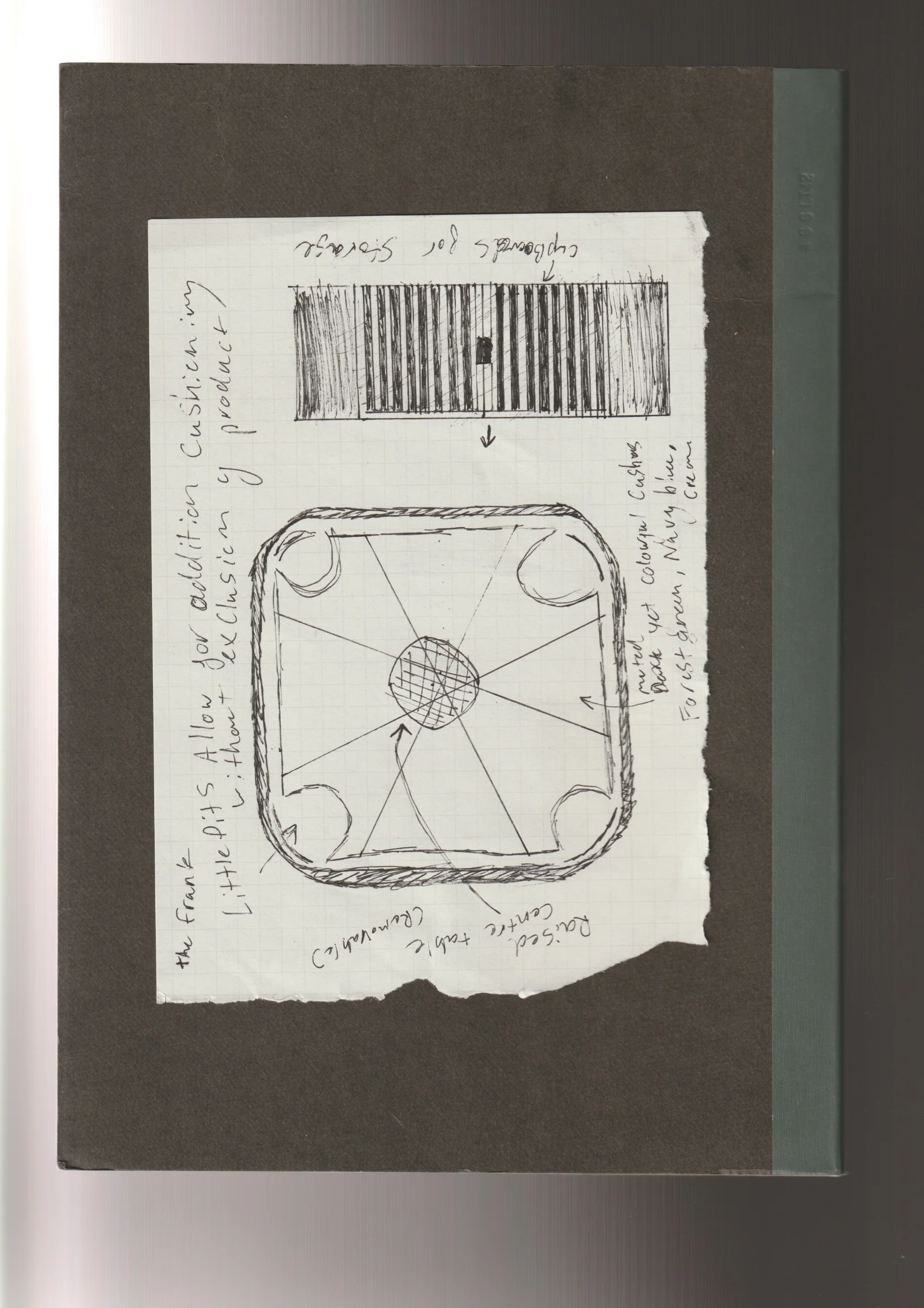
Despite the continuing communication issues within the group, I produced a series of concept sketches establishing the initial visual language and functionality of the FRANK range. Jasmine played a major role in helping present these ideas coherently during critique sessions, and together we shaped a clearer identity for the project. The presentation was ultimately successful and helped position FRANK as a viable direction moving forward.
Development, Experimentation, and Proof of Concept
January and February became the primary experimentation period for the project. During this time there was little urgency from much of the group due to the deadline still appearing distant. However, I felt increasingly frustrated because the lack of progress limited how ambitious the project could become. Jasmine and I continued discussing aesthetic references extensively, eventually drawing heavily from IKEA catalogues from the 1950s through to the 1970s. These catalogues communicated domestic optimism in a way contemporary branding often does not. Their visual language felt human, warm and accessible rather than hyper corporate or excessively technological. This became central to FRANK’s visual identity because we wanted the brand to feel approachable and sincere rather than futuristic in a stereotypical science fiction sense.
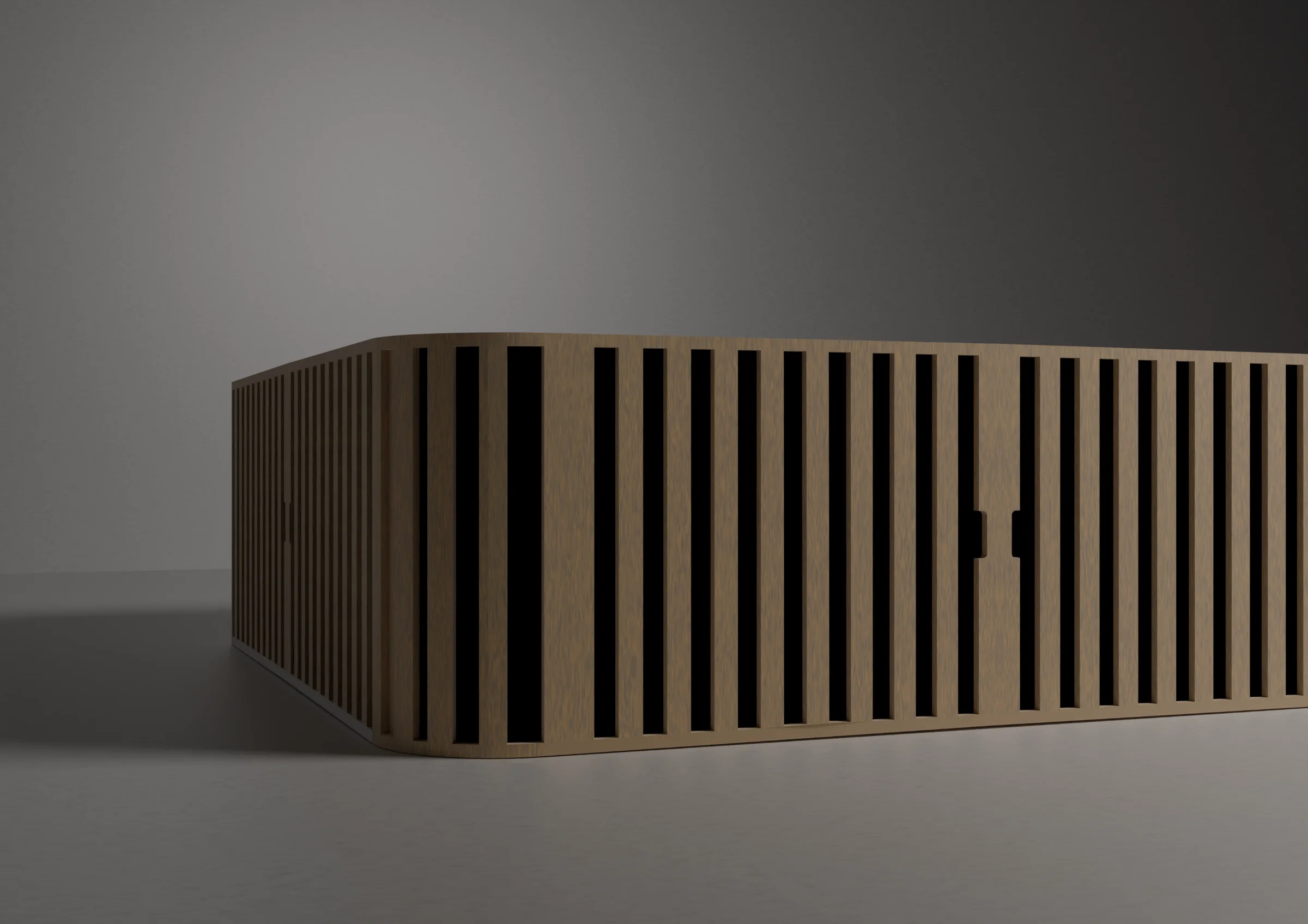
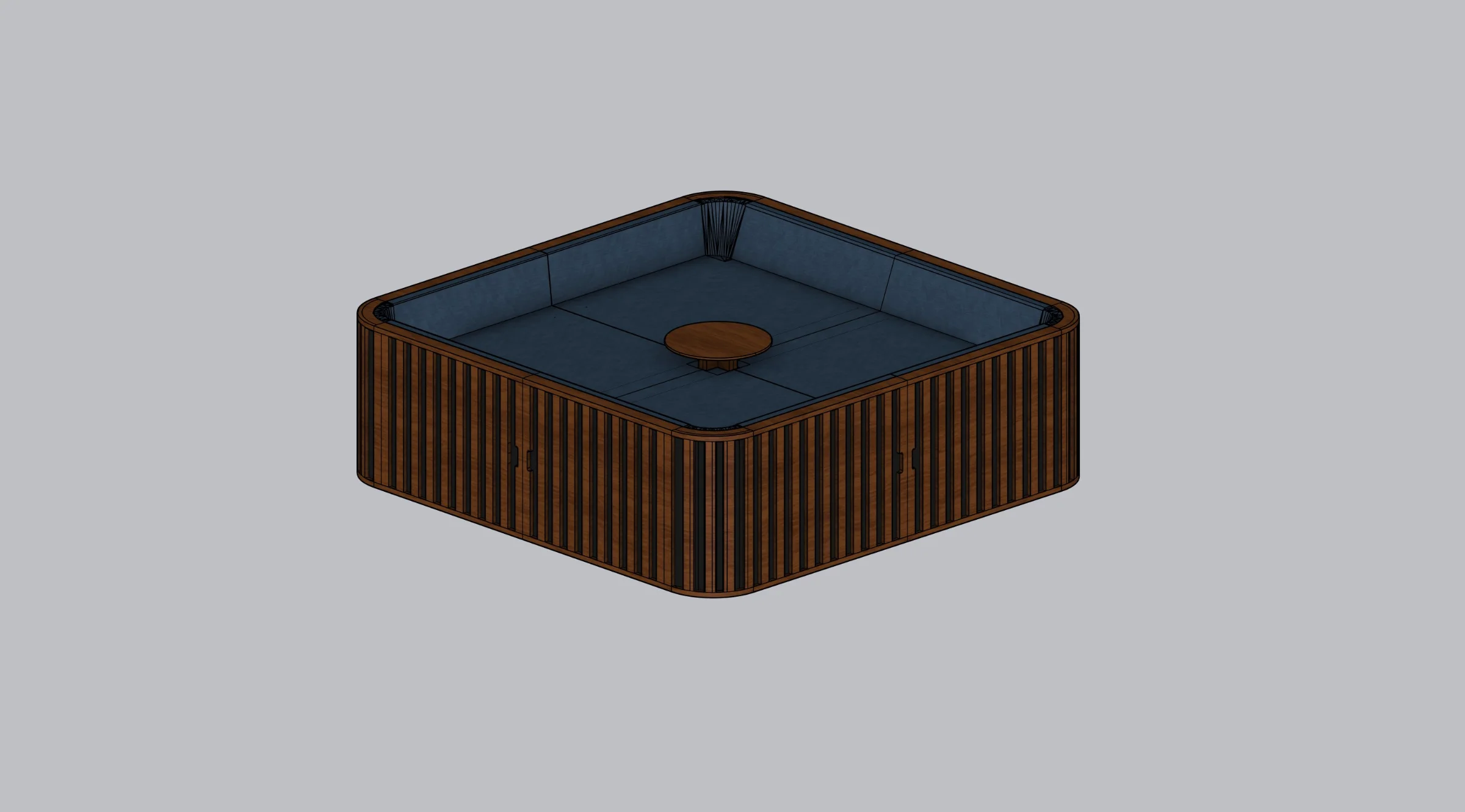
I began producing prototype designs for multiple furniture pieces within the FRANK brand. The first was The Frank itself: a four seated sofa arrangement organised around a central open space. The design treated furniture as social architecture rather than passive decoration. Instead of orienting users toward a television, it physically oriented them toward each other. The geometry encouraged eye contact, discussion and shared attention, transforming the sofa into something that actively shaped behaviour within the room.
This central argument became one of the most important ideas within the entire project. Most conventional sofas are designed to point people toward a screen. Living rooms therefore become spaces where people sit together physically while mentally focusing elsewhere. Conversation becomes secondary to distraction and entertainment. FRANK challenged this through its structure. It was not anti technology, but it questioned why domestic furniture no longer prioritised human interaction. In many ways the project was influenced by the historical idea of the conversation pit, a spatial arrangement popularised during the mid twentieth century where furniture lowered users into a shared communal environment. However, unlike many conversation pits that became enclosed and exclusive, FRANK’s later designs aimed for openness and accessibility.
Alongside this, I developed The Frankie, a smaller enclosed seating space inspired by my own experiences working creatively in isolated corners of rooms. I noticed that some forms of authenticity emerge socially, while others emerge privately. The Frankie therefore represented focus, comfort and introspection rather than conversation. This balance between outward social interaction and inward reflection became one of the more honest aspects of the project because it acknowledged that authentic living is not always performative or communal.
The Ivy was developed as a room divider allowing plants to grow directly through the structure. The intention was to introduce something organic and living into domestic interiors increasingly dominated by technology and media. The object functioned almost as a permeable architectural boundary, separating spaces without isolating them completely. However, I eventually abandoned the design because I doubted the amount of effort required would be matched by the effort being contributed elsewhere within the group.
Throughout this period I continued researching authenticity and material culture, eventually discovering Siân Jones’ paper Negotiating Authentic Objects and Authentic Selves (Jones, 2010). Jones argues that authenticity is not an intrinsic quality existing within objects themselves, but something created relationally through lived experience and emotional connection. This became extremely important to the conceptual framing of FRANK. The furniture was not supposed to be authentic simply because it used natural materials or minimalist aesthetics. Instead, its authenticity emerged through the social interactions and experiences it enabled.
Baudrillard’s The Consumer Society further reinforced this position by arguing that contemporary objects are increasingly consumed for image and symbolic value rather than practical function (Baudrillard, 1970). This felt especially relevant when considering modern furniture culture, where many sofas are designed primarily for online aesthetics or aspirational lifestyle imagery. FRANK deliberately pushed against this idea by prioritising communication and presence over image culture. Similarly, Simulacra and Simulation discusses how modern society becomes dominated by representations and appearances rather than authentic experience (Baudrillard, 1981). The Frank sofa attempted to counter this through direct physical interaction and shared embodied presence.
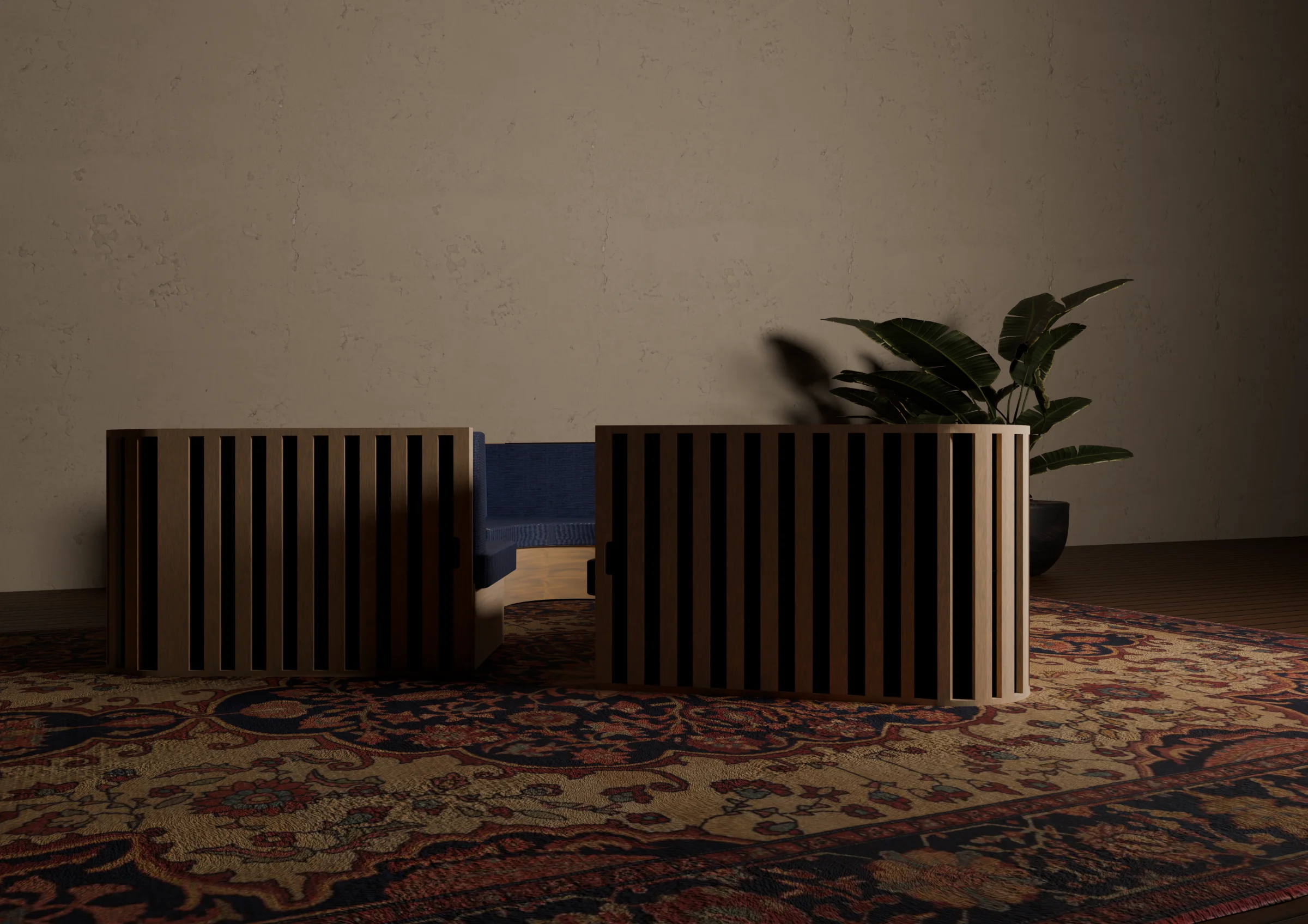
At this stage I also taught myself multiple software environments including SketchUp, Fusion 360 and Blender. Blender in particular became essential because the rest of the group increasingly relied on me to produce renders for their own deliverables. While I was proud of independently developing these technical skills, the pressure became increasingly stressful. Over time the renders almost became infrastructure for the project itself, and I felt some members used their dependence on my outputs as justification for not developing their own ideas further. Nevertheless, the renders became some of the strongest visual artefacts within the final submission because they allowed the furniture to exist convincingly within believable domestic spaces.
The Frank itself went through several design iterations. Version two resembled a high sided conversation pit, enclosed and immersive. The form created a strong sense of intimacy and atmosphere, almost functioning like a room within a room. However, it also posed accessibility issues and conceptually contradicted the openness the brand was intended to represent. Entering the furniture required climbing into it, making the object feel exclusionary rather than welcoming.
Version three solved this by opening the structure entirely. Each seat became independently accessible while maintaining the central shared void. The top down geometry resembled almost a graphic symbol, four separate corners framing an empty centre. This geometry eventually became the basis for the FRANK logo itself. Conceptually, the empty centre became just as important as the furniture around it because it symbolised the social space created between people rather than the object alone.
This redesign was heavily influenced by Situationist theory. Marcus describes the Situationist International as attempting to reclaim lived experience from passive spectacle and consumer passivity (Marcus, 1989). Debord similarly argues that modern society increasingly substitutes direct lived experience with representations of experience (Debord, 1967). Opening the sofa’s geometry therefore became a kind of architectural détournement, transforming a traditionally enclosed social form into something outward facing and participatory. Rather than allowing furniture to isolate people within media consumption, FRANK attempted to redirect attention back toward the physical presence of others.
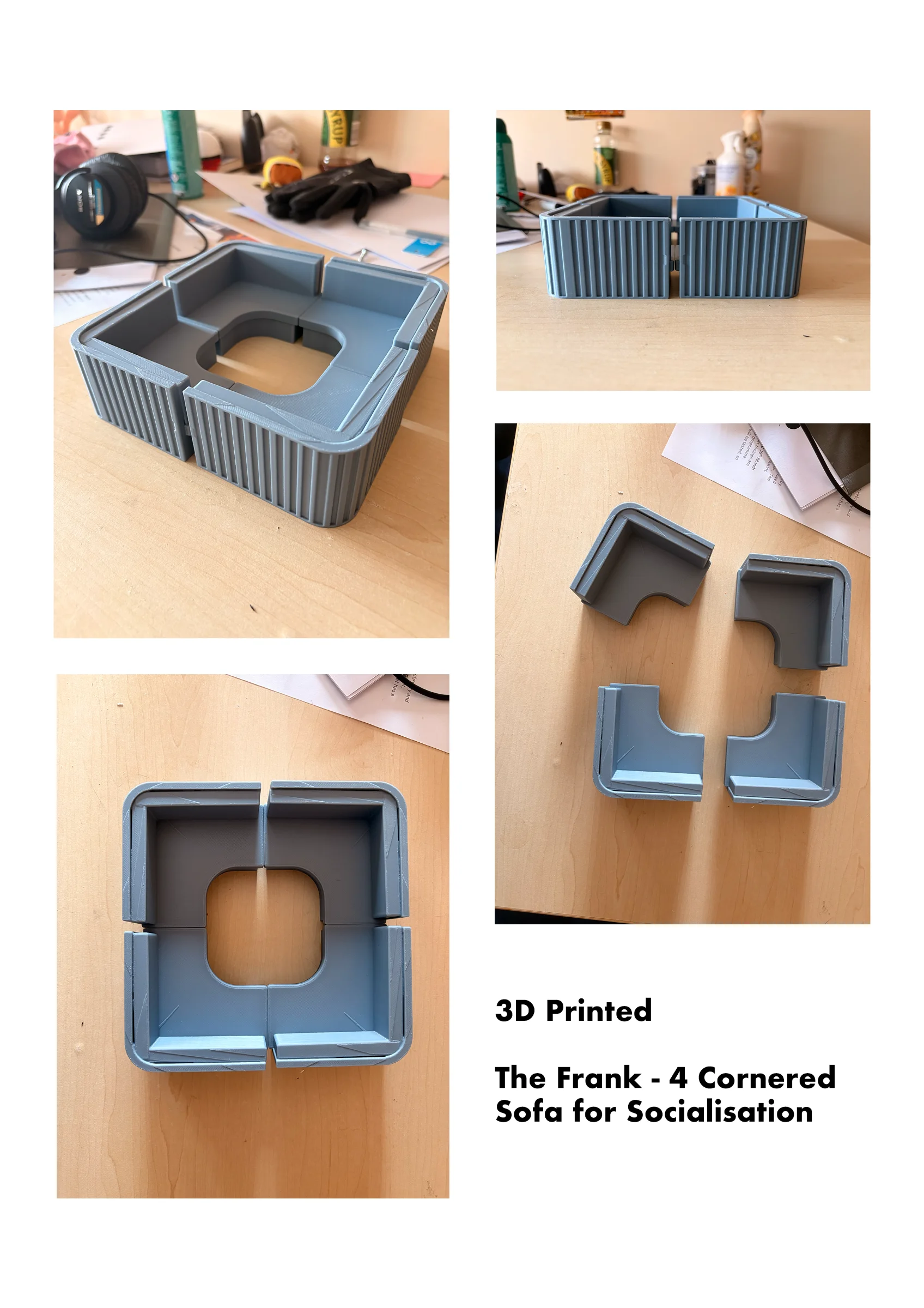
I also produced a 3D printed scale model of the final design in Warwick’s engineering building. The physical model became extremely important because it transformed the concept from an image into a tangible object. The model allowed people to understand the geometry through touch and spatial interaction rather than simply through renders. This strongly connected with Maurice Merleau Ponty’s argument that understanding emerges through embodied perception rather than detached observation (Merleau Ponty, 1945). The project consistently attempted to prioritise physical interaction over passive spectatorship, and the model reinforced this idea materially.
A Transmedia Experience: How the Platforms Worked Together
The final submission assembled several distinct media artefacts into a transmedia experience, each platform communicating the project in a different way while reinforcing the same core philosophy.
The magazine was intentionally produced as a physical object rather than a digital publication because the project itself argued for moving people away from purely digital interaction and toward embodied experience. Creating the magazine physically allowed it to embody the same values as the furniture. The visual language drew heavily from 1960s and 1970s IKEA catalogues through typography, colour palettes and paper texture, creating a sense of domestic warmth and optimism.
The magazine also acted as the clearest narrative artefact within the project. It contained visual and written explanations of FRANK, posters establishing the brand’s tone, and interviews discussing how furniture and architecture influence social behaviour. This aligned strongly with Lefebvre’s argument that domestic space is socially produced and ideologically meaningful rather than neutral (Lefebvre, 1974). The magazine therefore functioned not simply as promotion, but as an extension of the project’s theoretical framework.
The manifesto formed the ideological foundation of the brand. Rather than functioning like a conventional mission statement, it treated furniture as a political and philosophical object. The manifesto argued that the conventional sofa acts as “directional propaganda”, positioning human relationships as secondary to screen content. FRANK’s response was structural rather than moralistic. The geometry itself redirected attention toward the person opposite you. The line “we provide the geometry, you provide the humanity” captured this idea concisely.
The manifesto also successfully integrated academic theory into the brand voice itself rather than separating theory from branding. Debord’s Society of the Spectacle shaped the critique of mediated experience (Debord, 1967), while Merleau Ponty’s work on embodied perception reinforced the importance of physical interaction (Merleau Ponty, 1945). Lefebvre informed the project’s understanding of domestic space (Lefebvre, 1974), Arendt’s The Human Condition shaped ideas surrounding genuine conversation and public presence (Arendt, 1958), while Taylor’s Ethics of Authenticity reinforced the idea that identity develops relationally through dialogue with others (Taylor, 1991). These references gave the manifesto intellectual depth without making it inaccessible.
The social media campaign functioned differently again because it deliberately operated inside the same digital systems the project critiqued. Rather than purely advertising products, the posts attempted to educate audiences and redirect attention back toward physical interaction. The page included teaser posts, product shots, interactive posts, giveaway campaigns and awareness posts tied into the fictional narrative surrounding Frank Fielding. Conceptually, the social media existed as a contradiction: using digital media to encourage disengagement from excessive digital dependency.
Finally, the website acted as a visual archive collecting all artefacts together within one structured environment. Inaya designed the site using Swiss design principles and minimalist layouts inspired partly by brands such as Rimowa. The site used rule of thirds composition, section dividers and negative space to create clarity and restraint. The website contained separate sections for the manifesto, social media outputs and magazine, allowing audiences to move between each artefact while maintaining a coherent visual identity.
Reflection: What I Learned and Where I Go Next
The project taught me as much about collaboration as it did about design. Conceptually, working through Baudrillard, Debord, Lefebvre and Jones clarified my interest in the relationship between design, ideology and authenticity. I became increasingly interested in how objects silently organise social behaviour and how branding functions as a semiotic system rather than purely commercial decoration.
The project also taught me the importance of experimentation and technical adaptability. Learning SketchUp, Fusion 360 and Blender independently allowed me to realise the project visually, but also highlighted how technical labour within group projects can become invisible when absorbed into collaborative outputs.
Most importantly, the project taught me that creative work depends heavily on communication, accountability and shared momentum. FRANK succeeded because enough people eventually contributed enough to make the concept coherent, but the process exposed how fragile collaborative practice can become when communication deteriorates.
FRANK began as an abstract discussion about the future of creativity. It became a sustained argument about authenticity, media consumption and domestic space. What started as a sofa facing the wrong direction ultimately became a critique of how postmodern society directs attention itself.
References
Arendt, H. (1958) The Human Condition. Chicago: University of Chicago Press.
Baudrillard, J. (1970) The Consumer Society. London: Sage (1998 trans.).
Baudrillard, J. (1981) Simulacra and Simulation. Translated by S. Glaser (1994). Ann Arbor: University of Michigan Press.
de Certeau, M. (1984) The Practice of Everyday Life. Berkeley: University of California Press.
Debord, G. (1967) The Society of the Spectacle. Translated by D. Nicholson-Smith (1994). New York: Zone Books.
Jones, S. (2010) Negotiating Authentic Objects and Authentic Selves. Journal of Material Culture, 15(2), pp. 181–203.
Lefebvre, H. (1974) The Production of Space. Translated by D. Nicholson-Smith (1991). Oxford: Blackwell.
Marcus, G. (1989) Lipstick Traces: A Secret History of the Twentieth Century. Cambridge, MA: Harvard University Press.
Merleau-Ponty, M. (1945) Phenomenology of Perception. Translated by C. Smith (1962). London: Routledge.
Müller-Brockmann, J. (1961) Grid Systems in Graphic Design. Zurich: Niggli.
Raspaud, M. and Voyer, J-P. (eds.) (1974) Leaving the Twentieth Century: The Incomplete Work of the Situationist International. Translated by C. Gray. London: Free Fall Publications.
Taylor, C. (1991) The Ethics of Authenticity. Cambridge, MA: Harvard University Press.